Succulents Planted in Baskets: Beautiful Ideas to Decorate Your Home

Succulents are among the easiest plants to incorporate into home decor, but placing them in traditional ceramic pots can sometimes feel predictable. If you want something warmer, softer and more natural, succulents planted in baskets are an excellent alternative.
Woven baskets bring texture to a room. Succulents introduce structure, colour and organic shapes. Together, they create a decorative combination that works beautifully in living rooms, bedrooms, kitchens, entryways and covered outdoor spaces.
The result can feel rustic, Mediterranean, bohemian, Scandinavian or contemporary depending on the basket, the plants and the surrounding decor.
- Why Use Baskets for Succulents?
- How to Plant Succulents in a Basket
- Best Succulents for Basket Arrangements
- 1. Large Succulent Basket for the Living Room
- 2. Hanging Succulent Basket
- 3. Succulent Baskets for an Entryway
- 4. Succulent Basket for the Kitchen
- 5. Bedroom Succulent Basket
- 6. Mediterranean-Style Succulent Display
- How to Make a Succulent Basket Look Professional
- Decorating Around Succulent Baskets
- Light and Watering
- Final Thoughts
Why Use Baskets for Succulents?
A basket immediately makes a succulent arrangement feel less formal.
Instead of looking like a single plant placed on a shelf, the arrangement becomes part of the interior design.
Natural materials such as:
- seagrass;
- rattan;
- jute;
- wicker;
- water hyacinth;
- woven palm;
- cane;
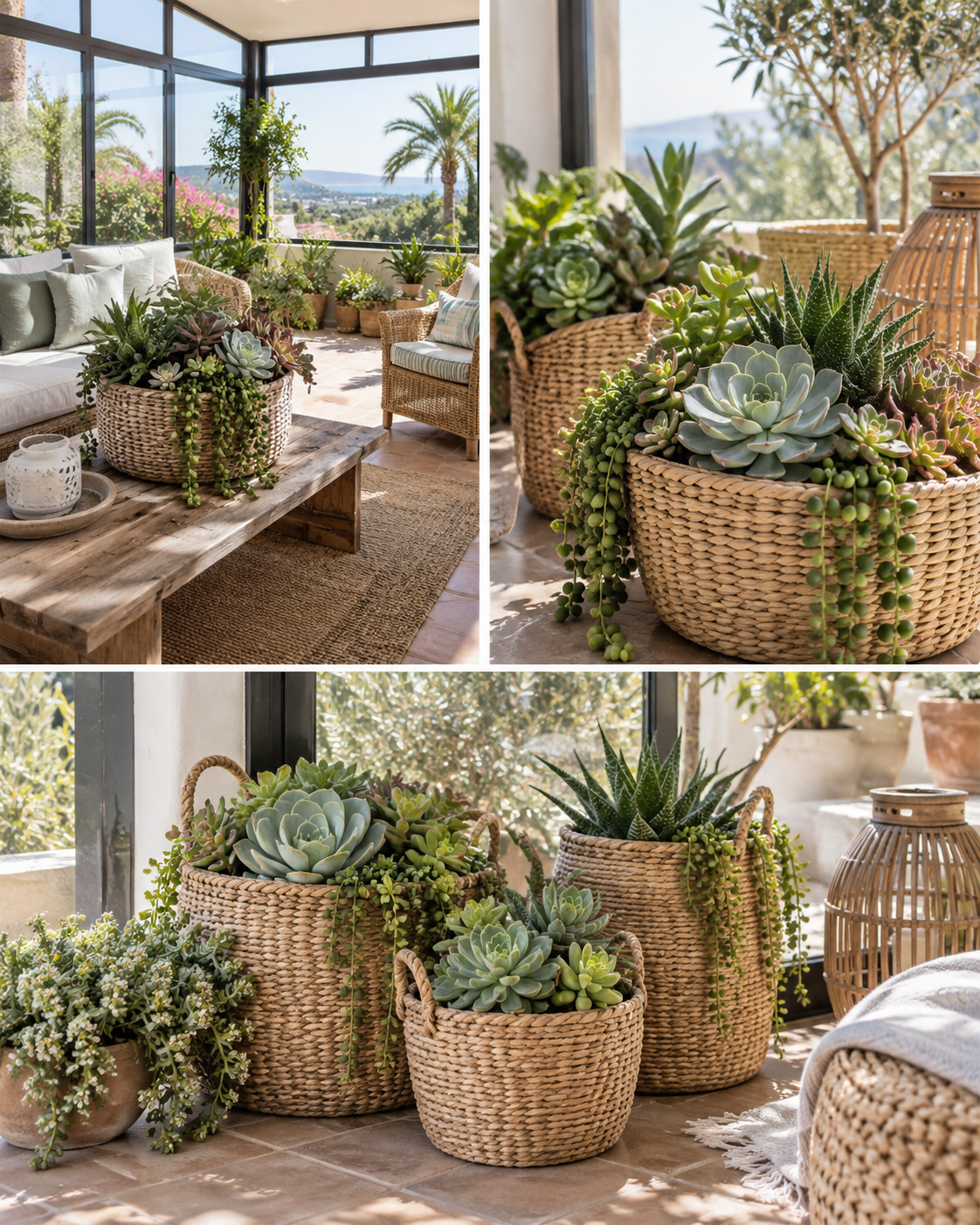
pair especially well with the muted green, blue-green and grey tones commonly found in succulents.
Another advantage is scale.
A small ceramic pot may hold one or two succulents, while a wider basket allows you to create an entire miniature garden using several varieties.
You can combine tall, compact and trailing plants in the same arrangement.
The most attractive succulent baskets usually combine different shapes, heights and textures rather than relying on many plants of the same type.
How to Plant Succulents in a Basket
One important detail should not be overlooked: most decorative baskets are not designed to hold wet soil directly.
Moisture can damage the fibres and encourage mould.
The simplest solution is to place a suitable container inside the basket.
Use an Inner Pot
Choose a plastic, terracotta or lightweight planter that fits inside the basket.
Ideally, it should have drainage holes.
Place a saucer underneath if the basket will be used indoors.
This method gives you the appearance of a planted basket while protecting the natural material.
Choose the Right Soil
Succulents dislike sitting in wet soil.
Use a well-draining succulent or cactus mix.
You can also improve drainage by mixing the soil with materials such as:
- perlite;
- pumice;
- coarse sand;
- fine gravel.
Good drainage is particularly important when several succulents share the same container.
Best Succulents for Basket Arrangements
The beauty of a basket arrangement comes from mixing plants with different forms.
Echeveria
Echeverias are ideal focal plants.
Their symmetrical rosettes create a beautiful centrepiece, particularly varieties with pale blue, dusty green or soft purple leaves.
Place one large echeveria slightly off-centre rather than perfectly in the middle for a more natural composition.
String of Pearls
For movement and softness, add String of Pearls around the edge.
Its trailing stems can spill over the basket, creating contrast with the rigid woven texture.
Sedum
Many sedums are excellent filler plants.
They grow between larger succulents and help make the arrangement look lush rather than sparse.
Haworthia
Haworthias introduce sharper architectural shapes.
Their striped or patterned leaves work particularly well beside softer rosette succulents.
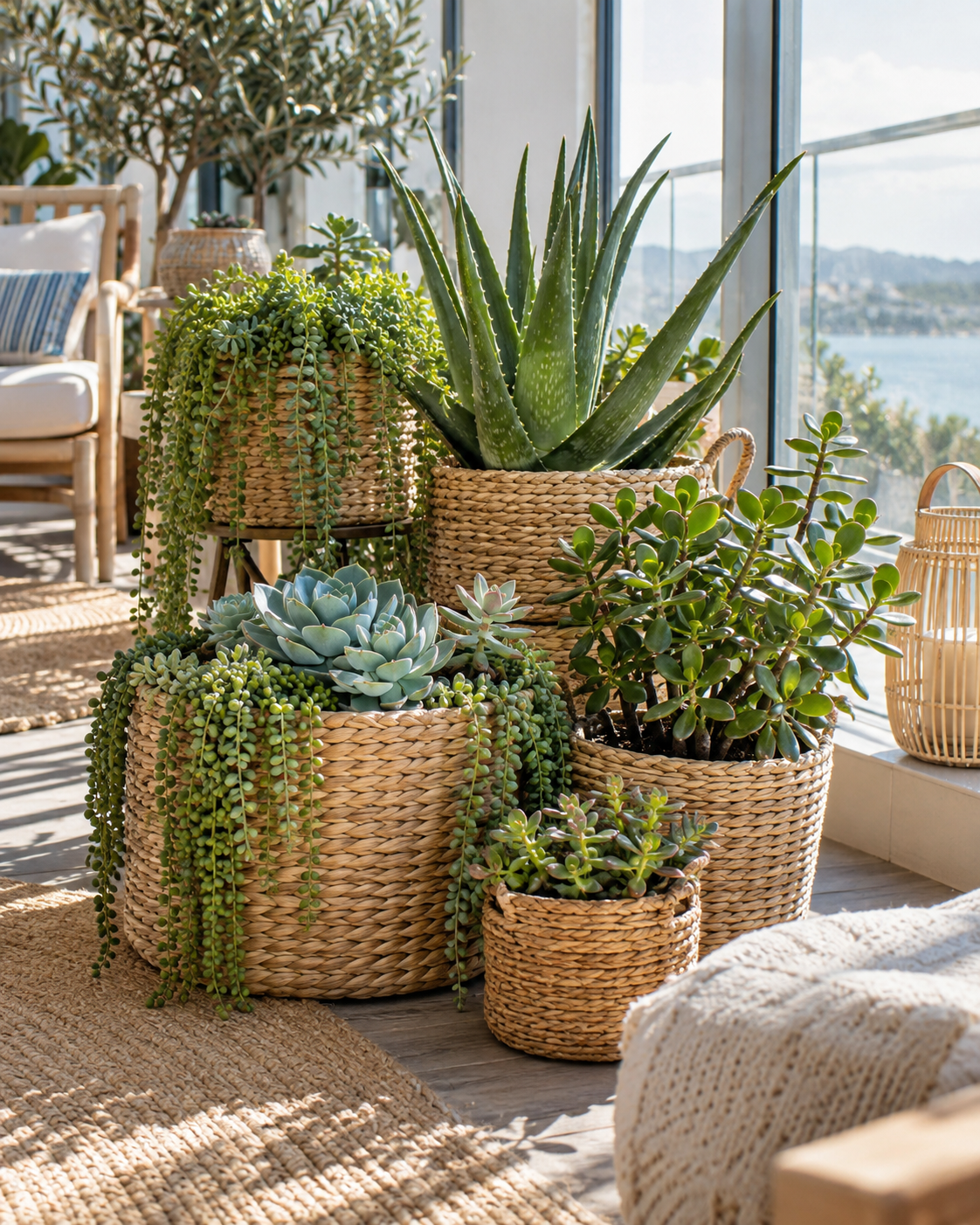
Jade Plant
Small jade plants add height.
Their rounded leaves also contrast beautifully with narrow-leaved succulents.
Aloe
For larger baskets, a compact aloe can act as a strong vertical element.
Avoid overcrowding it, as many aloe varieties grow considerably larger over time.
1. Large Succulent Basket for the Living Room
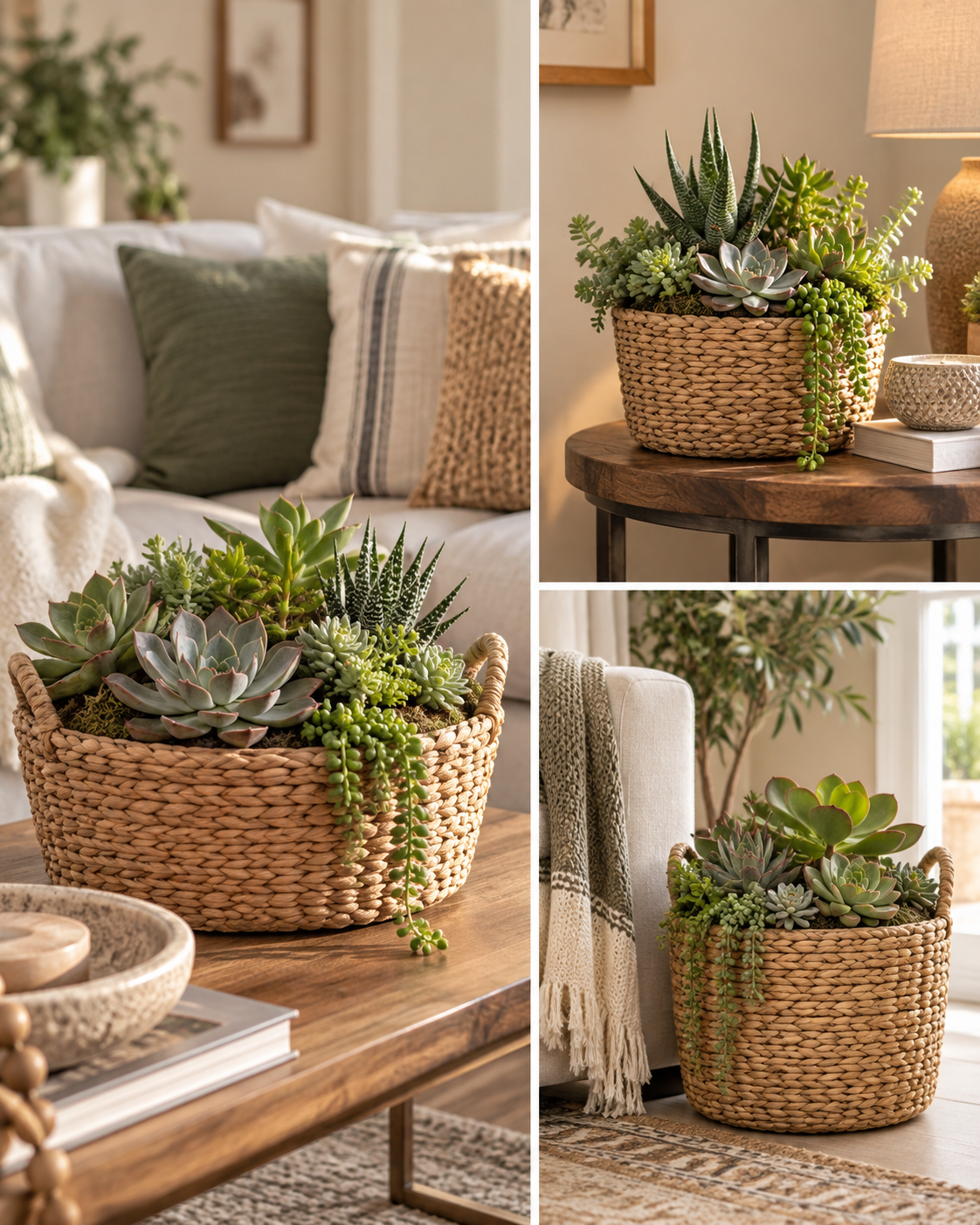
A large woven basket filled with succulents can become a natural centrepiece.
Place it on a wooden coffee table and combine:
- one large echeveria;
- two or three smaller rosettes;
- haworthia;
- trailing String of Pearls;
- compact sedums.
Keep the overall colour palette natural.
Soft greens, sage, blue-grey and muted purple usually work beautifully against warm wicker.
This type of arrangement fits especially well into rooms decorated with linen, wood, stone and neutral fabrics.
2. Hanging Succulent Basket
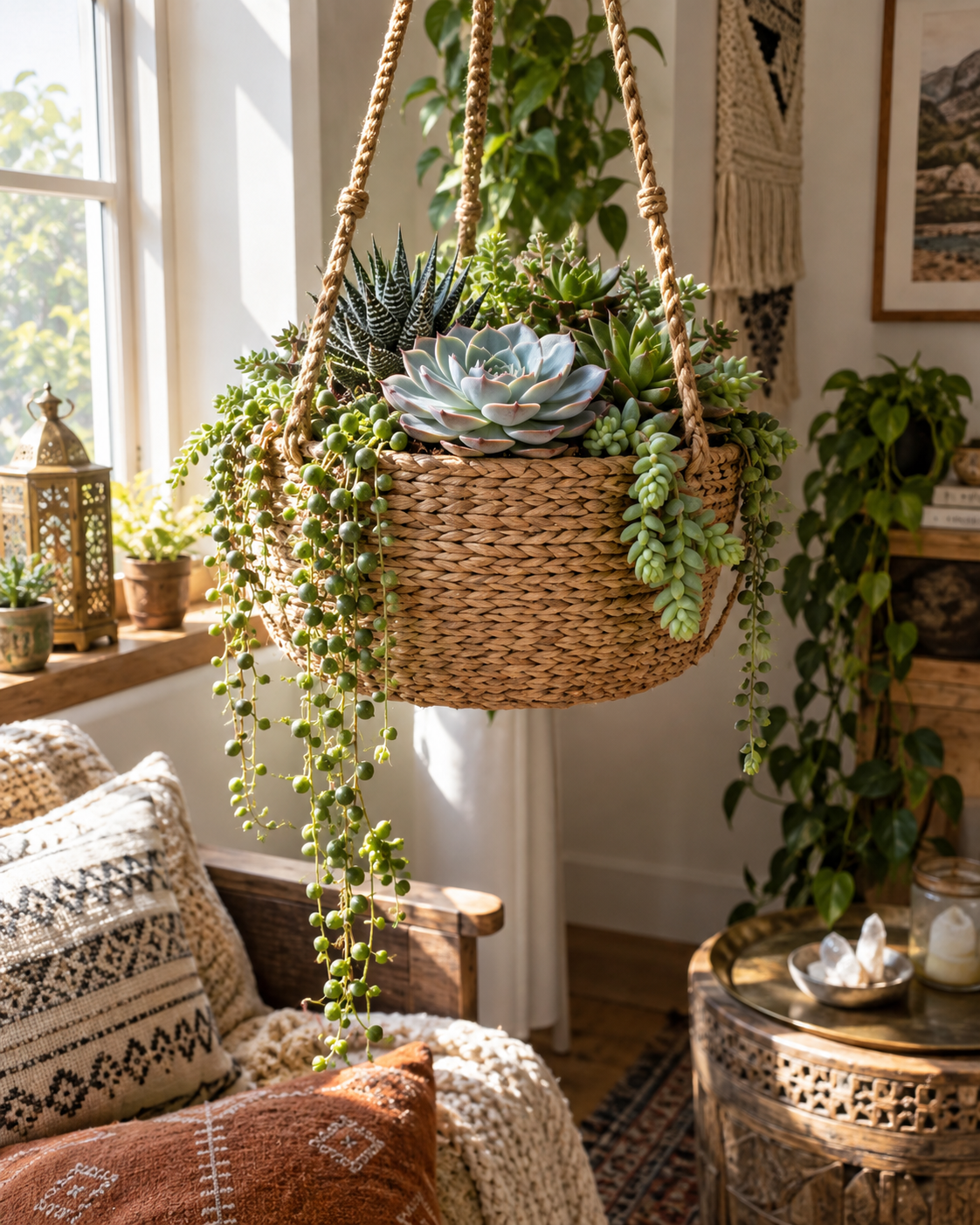
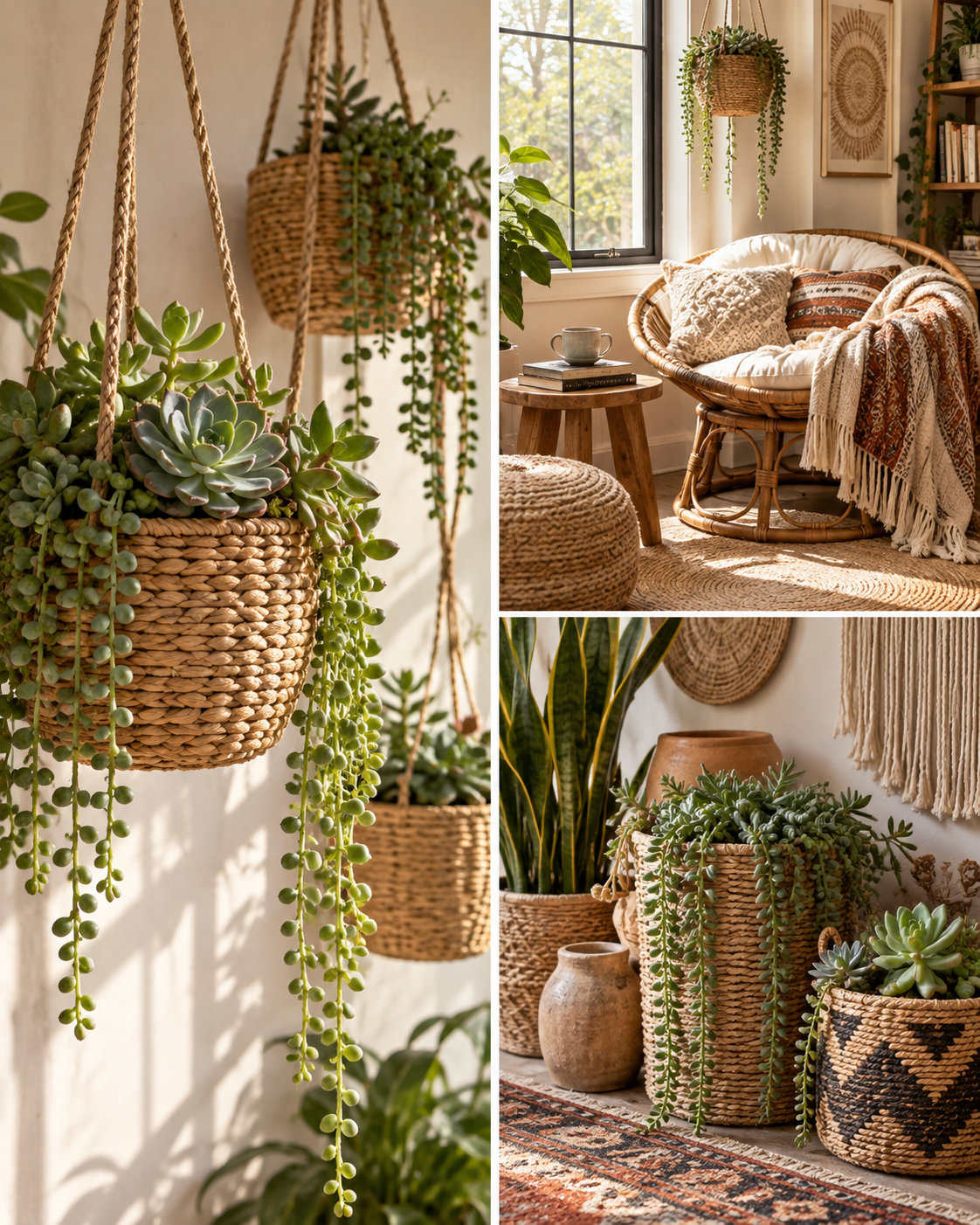
A hanging basket is perfect when floor and surface space is limited.
Choose a basket with secure handles or rope supports and fill it primarily with trailing varieties.
Try combining:
- String of Pearls;
- String of Bananas;
- trailing sedum;
- small echeverias.
Hang the basket close to a bright window.
The trailing plants will gradually cascade downward and soften the shape of the basket.
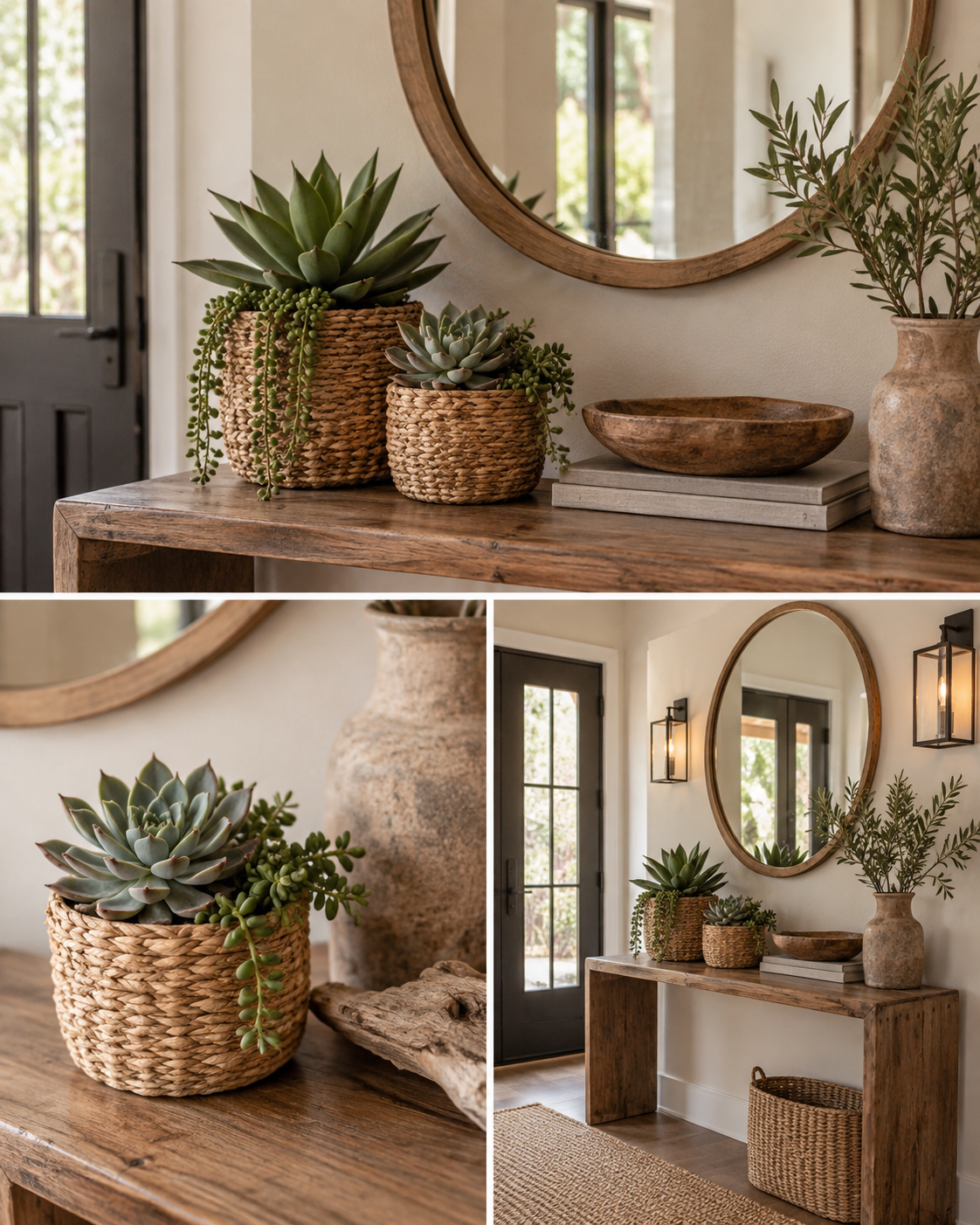
3. Succulent Baskets for an Entryway
An entryway is often overlooked when decorating with plants.
A wooden console table topped with two or three small woven succulent baskets can create an inviting first impression.
Instead of using identical baskets, vary the sizes.
For example:
- one tall narrow basket;
- one medium round basket;
- one small low basket.
Use a different dominant succulent in each container while repeating one trailing variety to visually connect the arrangement.
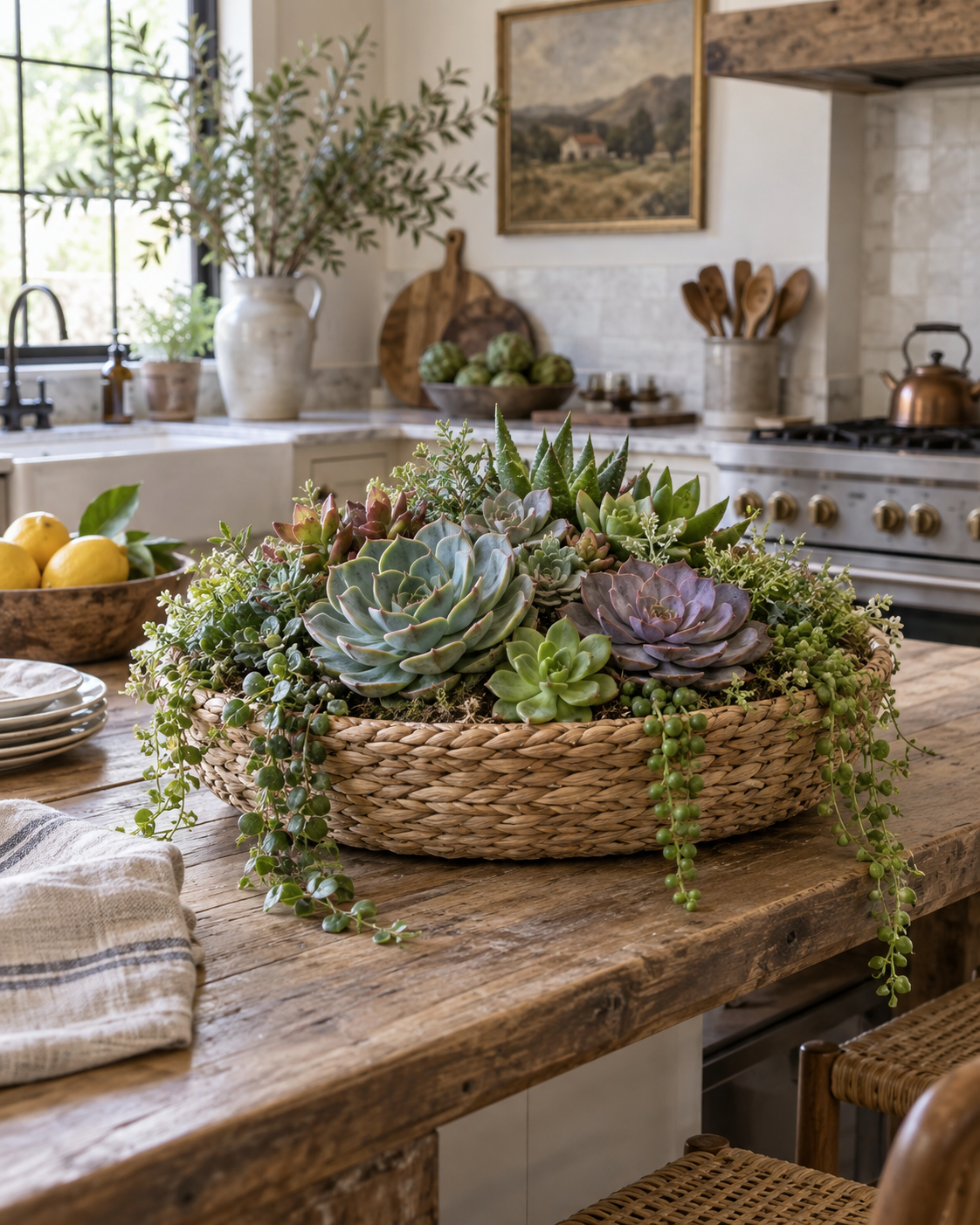
4. Succulent Basket for the Kitchen
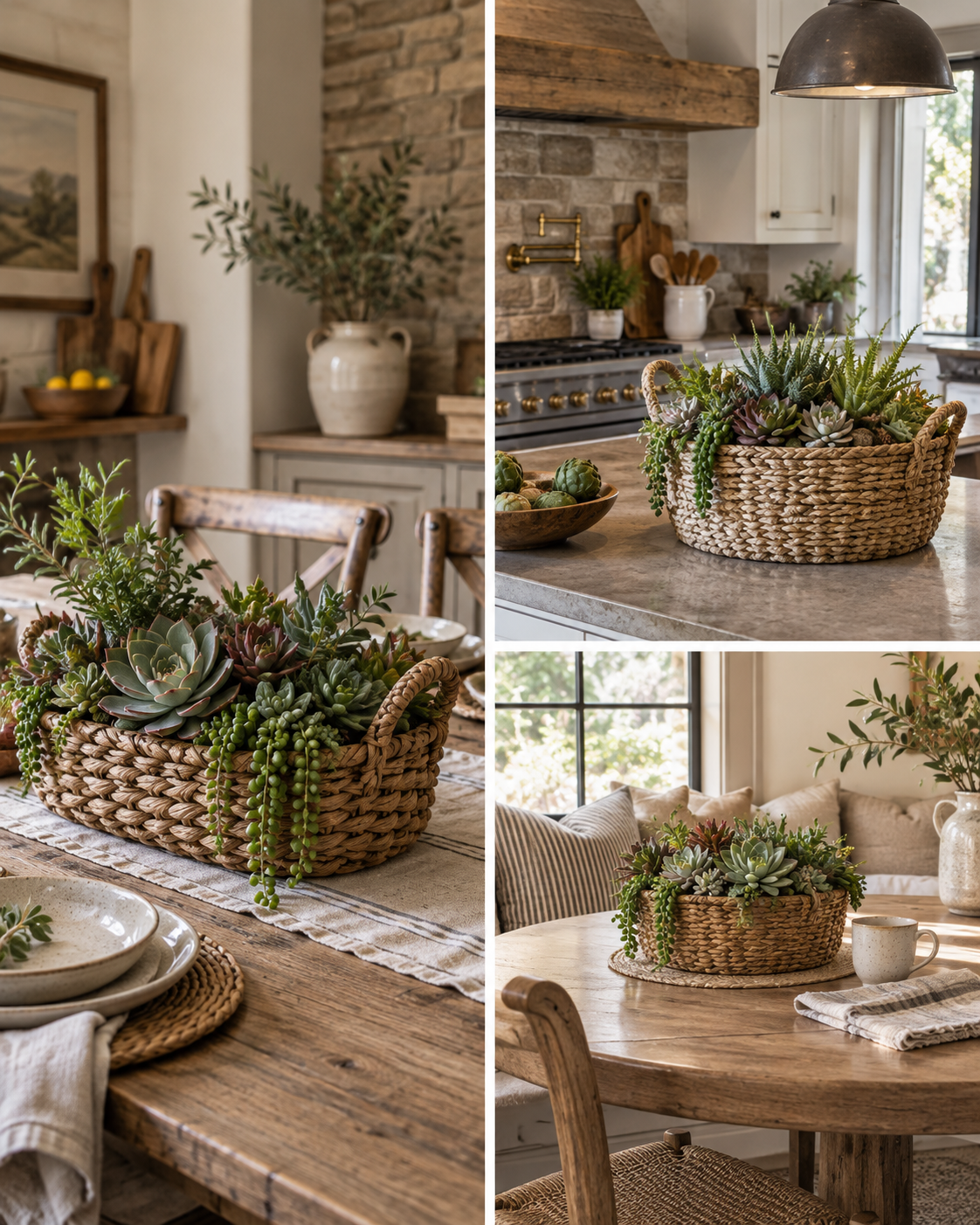
Succulents can work surprisingly well in kitchens, especially if the room receives good natural light.
A shallow basket filled with compact plants can sit on:
- a kitchen island;
- a breakfast table;
- a windowsill;
- an open shelf.
Keep the arrangement relatively low so it does not block sightlines across the room.
A wide, shallow woven basket with echeverias, sedum and small haworthias makes an attractive alternative to a traditional floral centrepiece.
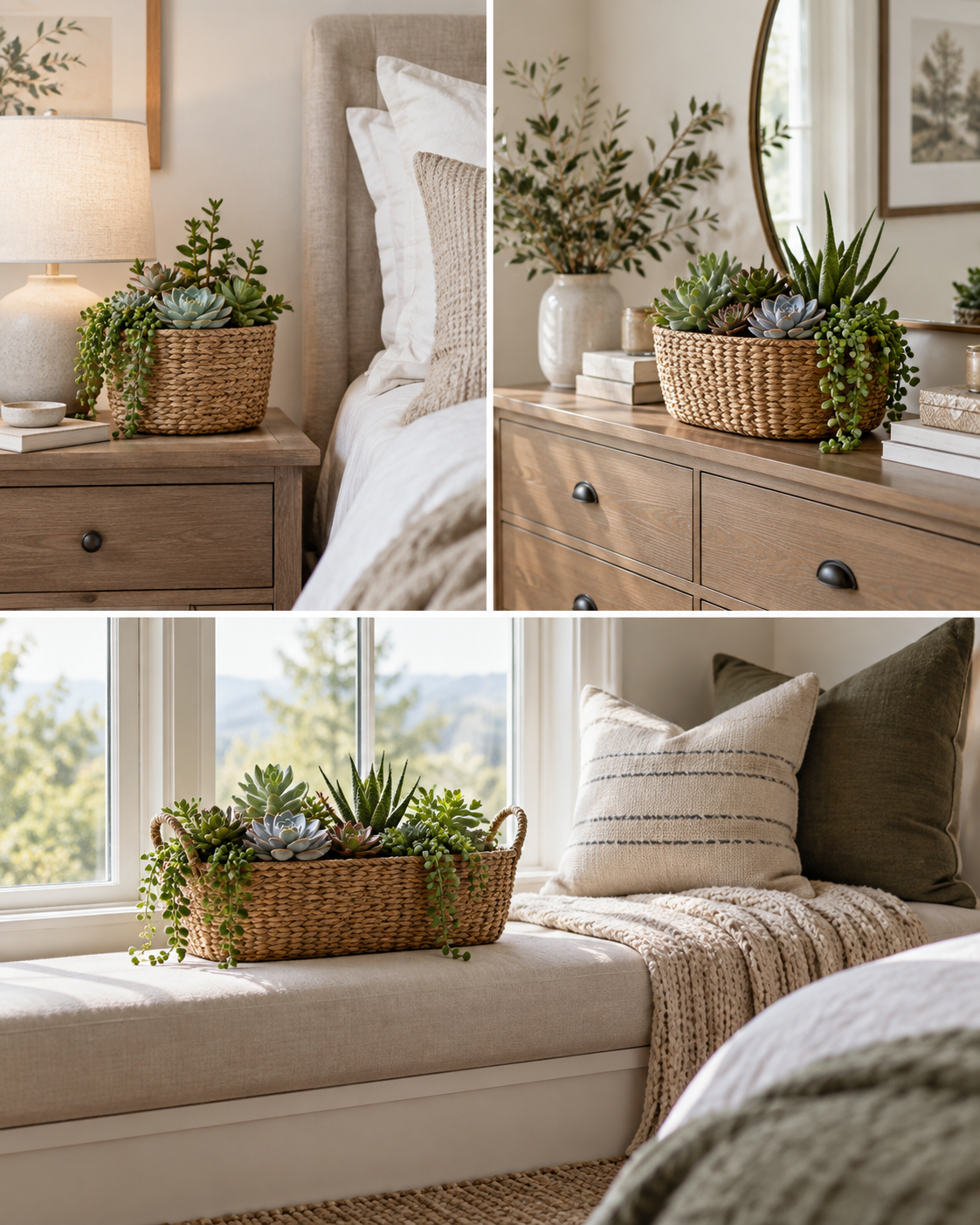
5. Bedroom Succulent Basket
Bedrooms often benefit from softer arrangements.
Choose a smaller basket with a simple weave and pair it with succulents in muted colours.
A pale echeveria surrounded by small green plants can look beautiful on a bedside table or chest of drawers.
Avoid making the basket too large.
The goal is to introduce texture without overwhelming the calm atmosphere of the room.
6. Mediterranean-Style Succulent Display
Succulents naturally complement Mediterranean interiors.
Combine woven baskets with:
- terracotta;
- aged wood;
- linen textiles;
- olive branches;
- stone accessories;
- warm neutral walls.
Use larger succulents such as aloe and jade alongside cascading varieties.
Several baskets grouped together can create a relaxed indoor garden effect.
This approach works particularly well near large windows, balconies or covered terraces.
How to Make a Succulent Basket Look Professional
A successful arrangement usually follows a simple structure.
Begin with one dominant plant.
Add one or two secondary varieties.
Then fill the spaces with smaller succulents and finish the edges with trailing plants.
You can think of the arrangement in three layers:
Height: aloe, jade or upright haworthia.
Body: echeveria, graptoveria or compact rosettes.
Movement: String of Pearls, trailing sedum or similar cascading varieties.
This prevents the composition from looking flat.
Decorating Around Succulent Baskets
The basket should feel connected to the room rather than added as an isolated object.
Try placing it beside materials that repeat its natural texture.
Wooden furniture, linen cushions, jute rugs and ceramic objects all work well.
For a minimalist home, choose a basket with a very simple weave and limit the arrangement to three succulent varieties.
For a bohemian interior, use larger baskets, trailing plants and mixed textures.
For a rustic home, slightly irregular handmade baskets often look better than perfectly symmetrical ones.
Light and Watering
Beautiful styling is important, but the plants still need the right conditions.
Most succulents need plenty of bright light.
Place baskets near a bright window whenever possible.
Water only when the soil has dried.
A useful method is to remove the inner planter from the decorative basket, water it thoroughly, allow excess water to drain and then place it back inside.
This helps prevent moisture from collecting at the bottom of the woven basket.
Final Thoughts
Succulents planted in baskets combine two of the most appealing elements in natural home decor: living greenery and woven texture.
They can be small enough for a bedside table or large enough to become the focal point of an entire room.
The key is variety.
Mix sculptural rosettes with upright plants and trailing succulents. Choose baskets that complement the materials already present in your home, and always ensure the plants have proper drainage.
With a little planning, a simple woven basket can become a beautiful indoor succulent garden that brings warmth, colour and texture into almost any space.